 Get Insights


Saudi MDMA Rule Cuts OCT Registration to 8 Weeks
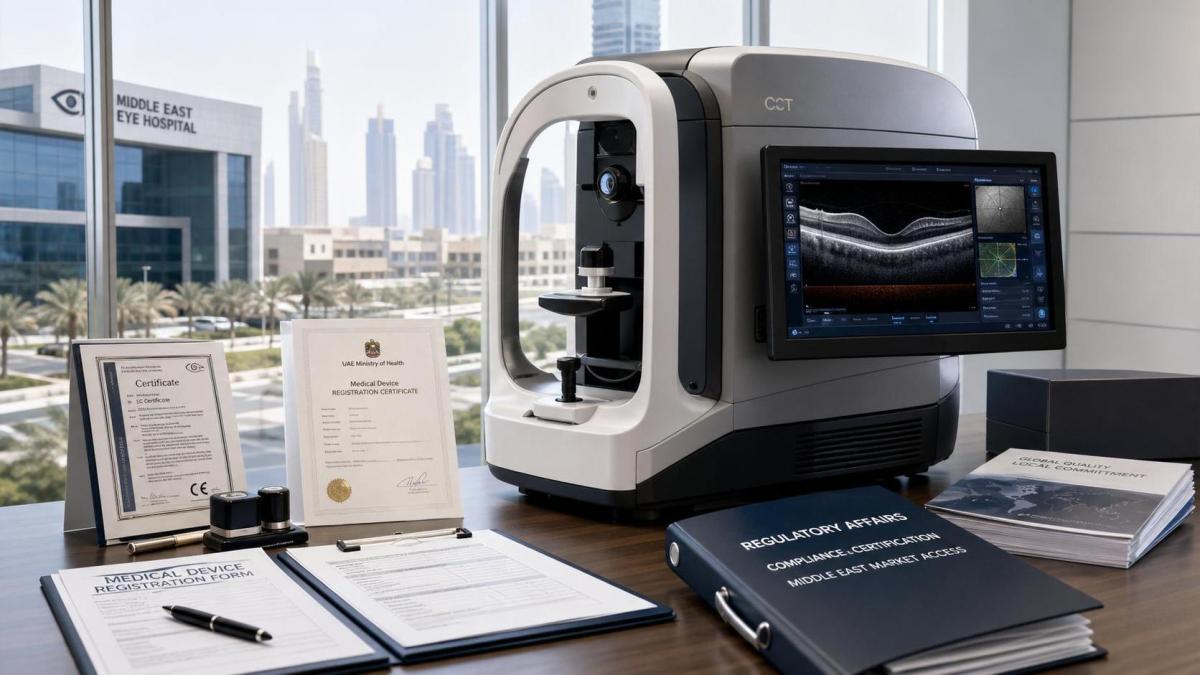
Saudi Arabia’s new MDMA market-entry rule took effect on June 19, 2026, creating a faster registration route for ophthalmic imaging devices such as OCT scanners. For exporters, local representatives, distributors, procurement teams, and compliance functions, the change matters because products already holding CE and ISO 13485 credentials may now move through registration with a shorter timeline when paired with China’s Medical Device Export Sales Certificate (II) and local authorization documents, changing how access planning and delivery coordination are approached.
What the rule now allows
According to the confirmed information provided, the Saudi Food and Drug Authority (SFDA) formally implemented the new MDMA medical device market access rule on June 19, 2026.
Under this change, a fast-track channel has been opened for ophthalmic imaging equipment, including OCT scanners.
Products that have already obtained CE and ISO 13485 certification may complete registration within 8 weeks, compared with the previous 20 to 26 weeks, if they submit China’s Medical Device Export Sales Certificate (II) together with local authorized representative documentation.
The summary provided also states that this channel is directly supported by progress in China-Saudi regulatory mutual recognition and by faster healthcare infrastructure development in the Middle East after the US-Iran ceasefire.
Where the operational impact is likely to appear first
Export planning shifts from long lead registration to document readiness
From an industry perspective, exporters of eligible ophthalmic imaging devices are likely to feel the impact first because the registration timeline is a direct part of market-entry planning. The practical change is not only speed, but also a greater dependence on whether the CE certificate, ISO 13485 certificate, China export sales certificate, and local representative file can be aligned without delay.
Local representatives become more central to market access execution
For authorized local representatives and channel-side operators, the rule highlights the importance of document completeness and submission coordination. Analysis shows that even where a fast-track window exists, execution will still depend on whether the representative’s authorization materials, filing sequence, and communication with the regulator are handled in a form acceptable under the new route.
Procurement and distribution may adjust timing assumptions
Buyers, distributors, and delivery planners may need to revisit assumptions around launch timing, tender preparation, and shipment scheduling for eligible products. What deserves closer attention is that a shorter registration cycle can affect when procurement discussions begin and how inventory or delivery commitments are sequenced, especially for products expected to enter the Saudi market under the new channel.
Compliance and certification service teams will need closer file control
Certification support, regulatory affairs, and testing-related service teams may also see workflow changes because eligibility under the fast-track route is tied to existing CE and ISO 13485 status and to specified supporting documents. The compliance focus is therefore likely to move toward document consistency, certificate validity, and readiness for submission rather than toward a broader reworking of technical qualification paths.
What companies should monitor in the near term
Check whether product scope clearly fits the fast-track route
Analysis shows that companies should first confirm whether their ophthalmic imaging products fall within the practical scope of the newly enabled pathway as described in the available information. Where the official execution wording is not fully provided in the input, it is safer to treat scope confirmation as an active compliance task rather than an assumed entitlement.
Prepare the required certificates and authorization files early
What deserves closer attention is the document chain itself. Companies planning exports should review the availability, validity, and consistency of CE, ISO 13485, China’s Medical Device Export Sales Certificate (II), and local authorized representative documents, because the value of a shortened registration window depends on whether the submission package is complete and accepted.
Watch for changes in filing practice and tender language
Observably, one of the most relevant next steps for market participants is to watch how the rule appears in filing requirements, procurement requests, distributor onboarding, and technical bidding documents. The input confirms the rule change, but it does not provide detailed operational guidance, so companies should continue tracking whether formal wording or market-side implementation introduces narrower interpretations or additional paperwork expectations.
Align delivery promises with compliance reality
For sales, supply chain, and after-sales teams, it is more appropriate to understand the 8-week timeline as a regulatory opportunity tied to conditions, not as a blanket delivery guarantee. Internal planning should therefore connect registration assumptions with shipment timing, installation readiness, and traceability responsibilities so that commercial commitments do not outrun compliance execution.
Why this looks like an execution signal, not the end of the story
Analysis shows that this development is best read as an implemented market-access change with immediate practical relevance, rather than as a general policy headline. At the same time, it is not yet the same as a fully settled operating norm across every transaction and every participant, because the provided information does not include detailed enforcement guidance, review practice, or feedback from actual filings.
From an industry perspective, the stronger signal is that recognized certification status and export documentation are becoming more directly connected to market-entry efficiency for eligible products. What deserves continued attention is how consistently that principle is applied in real registration work, procurement behavior, and channel-side execution.
How to read the significance of this update
This update is most appropriately understood as a concrete rule change that could shorten market-entry time for eligible OCT scanners and related ophthalmic imaging devices in Saudi Arabia. Its significance lies less in broad market claims and more in the practical link it creates between certification status, export documentation, local representation, and registration timing. For the industry, the prudent conclusion is that the change is already meaningful, but its full commercial and operational effect still needs to be assessed through subsequent implementation and market feedback.
Basis of this article
This article is generated from the user-provided news title, event date, and event summary. For events of this type, relevant source categories often include official regulatory notices, releases from supervisory authorities, trade or customs-related information, industry association updates, standards documentation, and reporting by authoritative media.
No specific official source link was provided in the input, so the exact official publication path still requires further verification. Continued monitoring is also needed for detailed implementation language, certification review practice, tender document changes, market feedback, and how companies actually execute registrations under the new MDMA route.
Recommended News
 Dental CBCT Equipment Cost: Budgeting for Purchase, Installation, and OwnershipDental CBCT equipment cost explained: budget for purchase, installation, software, service, compliance, and ownership to build a smarter, lower-risk imaging investment plan.
 How to Build a Global Medical Compliance Reference for Multi-Market Device LaunchesGlobal medical compliance reference: build a traceable, market-ready framework that links requirements, evidence, claims, and lifecycle controls for successful device launches.
 How to Evaluate a Dental Chair Systems Manufacturer for Clinic ProjectsChoose a dental chair systems manufacturer with confidence. Compare ergonomics, infection control, digital compatibility, installation support, and lifecycle value for clinic projects.
 How to Evaluate Interactive Robotic Rehabilitation Systems for Stroke TherapyInteractive robotic rehabilitation systems for stroke therapy: learn how to assess safety, clinical evidence, workflow fit, data, and long-term value.
 Choosing Implant Dentistry Systems for Safe, Efficient Oral Surgery WorkflowsImplant dentistry systems for oral surgery: evaluate precision, digital workflows, sterilization, traceability, and supply support to build safer, more efficient surgical care.
 Where Wearable Rehab Technology Delivers Measurable Gains in Stroke RecoveryWearable rehab technology helps stroke programs improve gait, balance, arm use, and home practice with actionable data that guides smarter therapy decisions.
 Hospital Medical Device Technical Evaluation: Safety, Fit, and Lifecycle CriteriaMedical device technical evaluation for hospitals: explore safety, clinical fit, infection control, serviceability, and lifecycle criteria for smarter purchasing decisions.
 Medical Device Product Categories: How Hospitals Classify Equipment for Safer PurchasingMedical device product categories guide safer hospital purchasing. Compare clinical workflows, infrastructure, consumables, infection control, and lifecycle costs.
 Digital Dentistry Equipment Price: Budgeting for Scanners, CAD/CAM, and ROIDigital dentistry equipment price guide: budget for scanners, CAD/CAM, software, service, and total ownership costs. Build a practical ROI case before you buy.
 Which Phacoemulsification Parameters Matter Most for Dense Cataract Cases?Phacoemulsification technology parameters for dense cataracts: compare energy delivery, vacuum, flow, IOP control, and surge response for safer, stable surgery.
 Medical Equipment Specification Standards: A Practical Guide to Compliance ReviewMedical equipment specification standards guide: review compliance, essential performance, clinical fit, utilities, and lifecycle risks for safer procurement decisions.
 How to Evaluate a Digital Dentistry Systems Factory for Clinic Equipment ProjectsEvaluate a digital dentistry systems factory with confidence: compare workflow integration, quality control, documentation, installation, and long-term service costs.
 How to Evaluate an Infection Control Systems Wholesaler for Hospital ProjectsChoose an infection control systems wholesaler with proven compliance, validation support, local service, and transparent lifecycle costs for reliable hospital projects.
 Minimally Invasive Dentistry for Pediatric Care: Techniques and Case SelectionMinimally invasive dentistry for pediatric care: discover case selection, sealants, resin infiltration, and pulp-preserving techniques for healthier young smiles.
 What Is Smart Rehabilitation Equipment? Key Technologies for More Measurable TherapyExplore rehabilitation equipment smart technologies that deliver measurable therapy, adaptive support, and actionable data to improve patient outcomes and clinical decisions.
 How Real-Time Force Feedback Improves Safety in Exoskeleton RehabilitationReal time force feedback improves exoskeleton rehabilitation safety by detecting unstable loading, adapting support, and preventing harmful movement. Learn how it works.
 How to Evaluate Hemodialysis Systems for Hospitals and Clinics in Southeast AsiaHemodialysis systems Southeast Asia: explore key factors for hospitals and clinics, from water treatment and safety to service, consumables, and lifecycle cost.
 Medical Exoskeletons Battery Life: What Determines Runtime in Daily Rehabilitation?Medical exoskeletons battery life depends on patient needs, therapy tasks, and charging workflows. Learn how to assess runtime for safer, more efficient rehabilitation.
 What Is Driving Adoption of Minimally Invasive Dentistry in Middle East Clinics?Explore why minimally invasive dentistry Middle East clinics are adopting digital workflows, precision care, and stronger infection control to improve patient outcomes and growth.
 What Drives Ophthalmic Surgical Device Maintenance Costs Over the Equipment Life Cycle?Ophthalmic surgical devices maintenance cost: uncover life-cycle drivers, uptime risks, contract terms, and smarter budgeting strategies for reliable surgical capacity.
 How to Evaluate a Neuromuscular Stimulation Equipment Supplier for Clinical UseNeuromuscular stimulation equipment supplier guide for clinical teams: assess compliance, usability, consumables, service support, and lifecycle costs.






Global Trade Insights & Industry
Our mission is to empower global exporters and importers with data-driven insights that foster strategic growth.
Search News
Popular Tags
Industry Overview
The global commercial kitchen equipment market is projected to reach $112 billion by 2027. Driven by urbanization, the rise of e-commerce food delivery, and strict hygiene regulations.