 Get Insights



Femtosecond Laser Docking: How to Troubleshoot Repeated Suction Loss
Repeated suction loss during femtosecond laser docking calls for a pause to identify the failure pattern before another attempt. If laser delivery has begun, stop treatment through the device’s prescribed controls and preserve the treatment record. A new docking attempt does not establish that an interrupted treatment can safely restart. That decision requires the surgeon’s assessment of the treatment stage, ocular findings, and the system’s approved interruption procedure.
For femtosecond laser systems with docking, the most useful first distinction is whether suction never stabilizes, fails after an initially secure dock, or disappears during laser delivery. These patterns direct attention toward different causes: interface seating, patient movement, mechanical loading, or the vacuum pathway. Repeating the same maneuver without resolving the suspected cause adds manipulation and makes the original problem harder to interpret.
Establish when the failure occurs
Before repositioning anything, note the exact alarm, displayed vacuum status, patient movement, and treatment stage. “Suction loss” describes an event, not a diagnosis. A low-vacuum warning, an unstable interface, and a communication fault require different responses even if each prevents treatment.
These patterns guide investigation; none confirms a cause by itself. A vacuum reading within the permitted range also does not prove correct centration, acceptable corneal geometry, or accurate treatment imaging. Suction status and treatment alignment must each satisfy the device’s requirements.
Remove positioning forces before rebuilding the dock
A patient can appear still while the docking interface carries a continuous sideways load. Head rotation, unsupported neck posture, or a bed position that requires the eye to meet the interface at an angle can produce a marginal seal. The problem becomes visible only when fixation changes, facial muscles tighten, or the patient begins to relax.
Reassess the relationship between the head, eye, and docking assembly using the approved positioning sequence. Support should allow a comfortable, stable posture without requiring the patient to hold the head against a restraint or actively maintain alignment. If the head repeatedly returns to a different position, address that posture before another attempt.
Explain the immediate task in brief, concrete terms: maintain the requested fixation, avoid squeezing, and report discomfort before moving. Repeated instructions delivered during docking can increase tension. Pain, panic, persistent coughing, or an inability to remain still needs clinical reassessment rather than increasingly forceful coaching.
The eyelid speculum also deserves attention. Its position can transmit lid tension or crowd the docking interface, particularly when exposure is limited. Lashes, lid margins, or conjunctival folds entering the intended sealing area can interrupt contact. Any adjustment must preserve ocular protection and follow the interface-specific technique; forcing a ring into restricted exposure does not correct the underlying fit problem.
Tubing and cables should have the routing and support specified by the manufacturer. A line trapped under a drape or pulled taut can load the interface as the bed or docking assembly moves. Follow the line to its connection rather than inspecting only the portion nearest the eye.
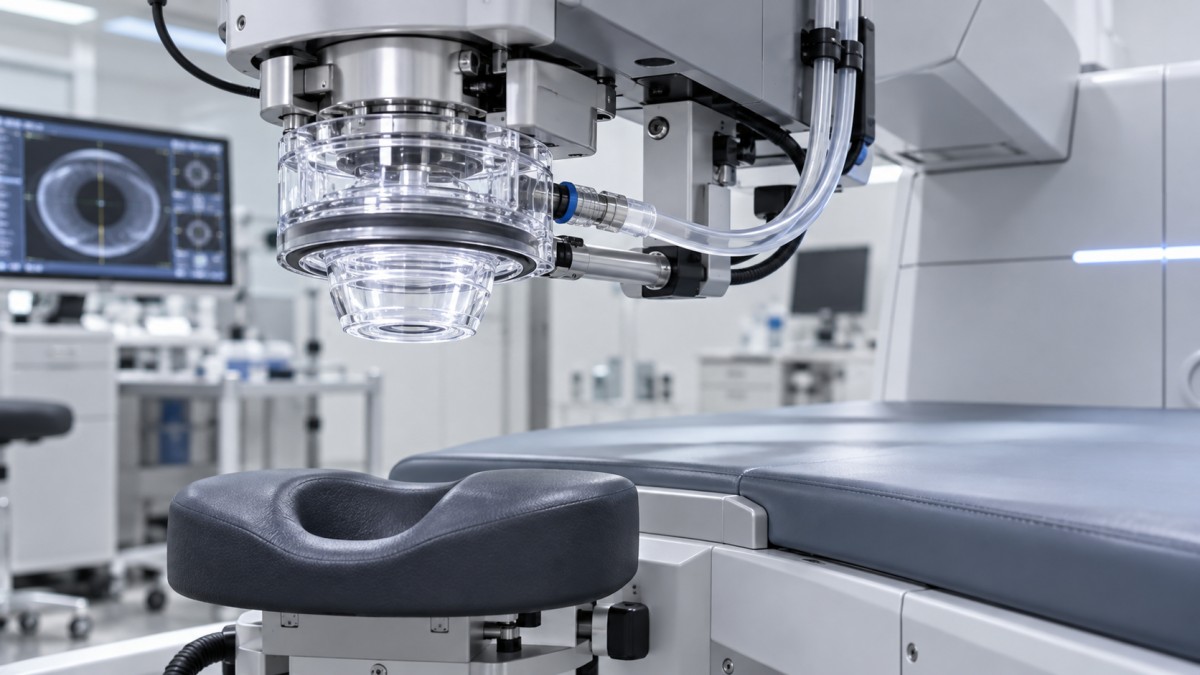
Inspect the interface according to its design
Contact interfaces and liquid interfaces do not share an interchangeable troubleshooting sequence. Their sealing surfaces, fluid requirements, coupling geometry, and permitted handling differ. Establish which design is in use before interpreting bubbles, fluid distribution, or apparent contact.
Sealing surfaces and disposable condition
Confirm that the patient interface is the correct type for the system and procedure, is within its labeled use conditions, and has been assembled as instructed. Inspect accessible components for deformation, damage, contamination, or incomplete engagement. A disposable that appears nearly seated can still leave an unreliable connection.
When tissue or debris interrupts the seal, correct the obstruction through the approved preparation and docking method. Do not compensate by applying extra downward pressure, changing vacuum settings outside approved controls, or manipulating a component beyond its intended travel. These actions can alter ocular loading without fixing the leak.
A suspected damaged or contaminated disposable should be managed under its labeling and local procedure. Single-use interfaces must not be improvised, repaired, or reprocessed to recover suction. If a replacement resolves the problem, retain the original device identification and lot information for investigation according to local handling requirements.
Fluid, bubbles, and optical coupling
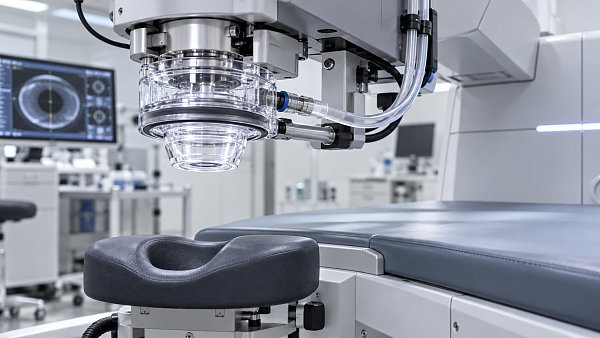
With a liquid interface, assess the prescribed fluid condition and optical path. A bubble in the imaging or treatment path can compromise visualization even when suction remains stable. Conversely, a clear optical path does not establish seal integrity. Treat optical coupling and vacuum retention as separate acceptance conditions.
Use only the specified fluid and filling method. Adding fluid indiscriminately can conceal the source of instability or introduce handling errors. For a contact interface, do not import filling or lubrication practices from another platform unless the instructions explicitly permit them.
If interface removal is required, release suction through the prescribed sequence before separation. Pulling against an active seal or twisting the assembly to break suction introduces avoidable mechanical stress.
Separate a local seal problem from a vacuum-system fault
A localized seal problem often changes when exposure, alignment, or interface seating is corrected. A vacuum-system problem becomes more plausible when instability persists with an apparently acceptable dock, recurs with replacement interfaces, or appears across patients. These observations support escalation; they do not justify testing a questionable system on additional patients.
Within the permitted setup checks, inspect accessible vacuum tubing for kinks, compression, disconnection, and insecure fittings. Verify that required consumables, collection components, or filters are installed correctly where the system uses them. Fluid in a pathway intended to remain dry requires the manufacturer’s specified response.
Use the device’s approved self-test or diagnostic workflow where available. A passed startup test does not exclude an intermittent fault under operating conditions, and a successful dock does not invalidate an earlier alarm. Preserve error codes and logs so technical support can compare the event with the system’s recorded status.
Do not bypass an interlock, defeat a vacuum alarm, open service-only components, or alter calibration to continue a case. Those actions remove safeguards and can obscure the failure. Unresolved vacuum faults require the system to be withheld from clinical use pending the appropriate technical assessment.
When suction is lost after treatment begins
The interruption point determines the next clinical decision. Suction loss before laser delivery creates a different problem from interruption after partial photodisruption. Once tissue has been treated, the surgeon must establish what was completed, what remains uncertain, and whether the platform supports a defined recovery pathway.
For corneal procedures, partial flap, lenticule, or related cuts can leave tissue planes whose continuity cannot be inferred from a progress indicator alone. Redocking can introduce differences in centration, rotation, or tissue geometry. Repeating a nominally identical treatment therefore requires a procedure-specific decision, not an assumption that the original plan remains valid.
During femtosecond-assisted cataract treatment, the implications differ between capsulotomy, lens fragmentation, and corneal incisions. An interrupted capsulotomy can leave tissue bridges; an interrupted fragmentation pattern does not establish complete lens separation. Subsequent surgical maneuvers must reflect the actual tissue findings.
Preserve treatment-screen information before dismissing messages or creating a new plan, provided this does not delay immediate patient care. Record the eye, procedure stage, displayed completion status, and any relevant imaging. A verbal statement that treatment was “almost finished” is too imprecise to support recovery decisions.
Resumption, modification, conversion, or deferral rests on the surgeon’s assessment and the platform’s approved instructions. There is no universal restart rule that applies across corneal and cataract procedures or across different laser systems.
Make another attempt only after a specific correction
A further docking attempt needs an identifiable reason to expect improvement. Examples include releasing trapped tubing, correcting head support, clearing an obstruction from the sealing area, or replacing a defective interface. “Try again” without a changed condition provides little diagnostic value.
Before proceeding, the relevant conditions should be satisfied:
- The suspected cause has been addressed, and the system reports an acceptable state through its prescribed checks.
- Ocular examination supports further docking. New pain, visible injury, significant chemosis, or another concerning finding requires assessment before additional manipulation.
- If treatment was interrupted, the surgeon has established an approved recovery plan based on the delivered treatment and current anatomy.
No universal number of attempts defines safety. Device instructions, ocular response, patient tolerance, and the reason for failure determine the limit. Even before a labeled limit is reached, repeated unexplained loss is a reason to stop. Increasing anxiety or progressive conjunctival swelling can also make subsequent docking less reliable.
Keep the failure record useful for the next case
Document the sequence with enough detail to distinguish a patient-specific difficulty from a recurring equipment problem. Useful entries include the interface type and lot, alarm text, timing relative to laser delivery, observed movement, corrective action, and whether that action changed the behavior. Record relevant ocular findings and the final treatment decision separately from assumptions about the cause.
For technical escalation, provide the system identifier, software version when available, diagnostic results, and the preserved event logs through approved channels. Note whether recurrence involved the same disposable, a replacement, or a different setup. These distinctions help narrow the investigation without exposing another patient to an unresolved fault.
Return to service should follow the documented resolution and required verification. A single successful docking attempt after an unexplained failure is insufficient evidence that an intermittent problem has been corrected.
Recommended News
 Medical Compliance Reference: U.S. Infection Control Rules vs. GuidanceUse this medical compliance reference to distinguish U.S. infection control rules from guidance, clarify OSHA, CMS, FDA and CDC roles, and identify gaps before your next audit.
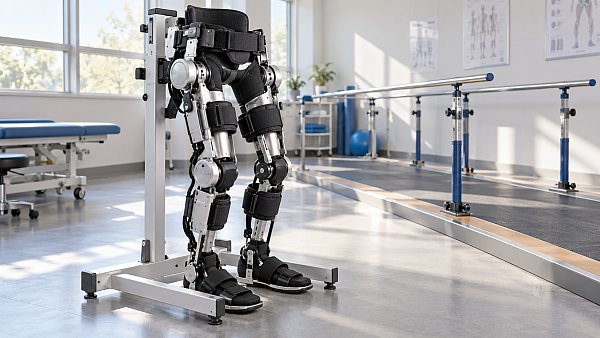
 Choosing Powered Exoskeleton Rehabilitation Devices for Post-Stroke Gait TrainingCompare powered exoskeleton rehabilitation devices for post-stroke gait training. Explore patient fit, safety, clinical evidence, and costs to choose the right system for your service.
 Commerce Ministry: Exoskeleton Sales on Key Platforms Rise 46.4% in Jan–Sep 2026Exoskeleton sales rose 46.4% on key platforms in Jan–Sep 2026, according to supplied Commerce Ministry data. Explore procurement insights and key checks for suppliers and buyers.
 Wearable Exoskeleton Rehabilitation Devices: Key Criteria for Gait TrainingCompare wearable exoskeleton rehabilitation devices for gait training. Discover key criteria for patient fit, safety, assistance, and clinical evidence to guide smarter selection.
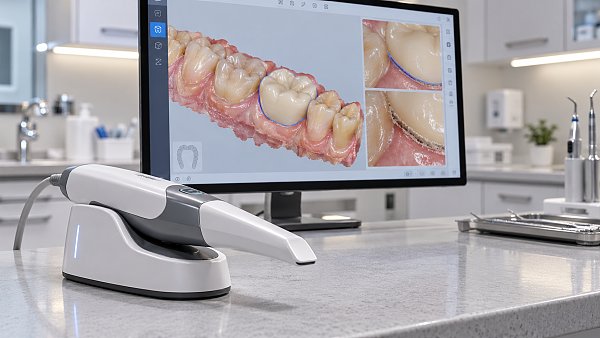
 3D Intraoral Scans Show High Specificity for Caries Around Restorations3D intraoral scans show high specificity for caries around restorations, but sensitivity varies. Explore what these findings mean for secondary caries assessment.
 Specialty Medical Equipment Specifications: Performance and Compatibility ChecksEvaluate specialty medical equipment specifications with practical performance and compatibility checks. Discover how to avoid costly mismatches and make confident hospital purchasing decisions.
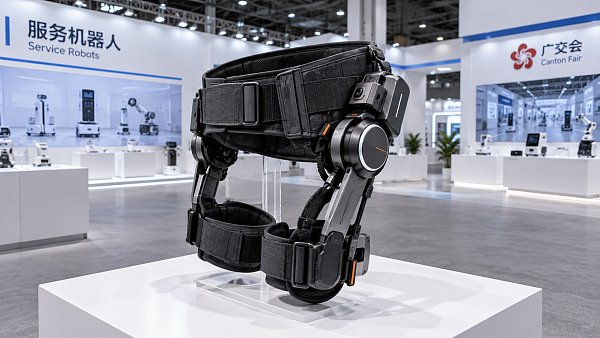
 Taixi Intelligent Exoskeleton Robot Showcased at the 140th Canton FairExplore Taixi Intelligent’s Yinyue X1 exoskeleton, reportedly showcased at the 140th Canton Fair. Discover its features and key compliance checks for overseas buyers.
 Robotic Rehabilitation Devices: How to Evaluate Systems for Gait TrainingCompare robotic rehabilitative medical devices for gait training. Discover how to assess patient fit, safety, clinical evidence, and costs to choose the right system for your program.
 UK Confirms Indefinite Recognition of CE-Marked Medical DevicesCE-marked medical devices gain indefinite recognition in Great Britain. Discover what this means for UKCA requirements, compliance planning and long-term supply continuity.
 Electric Dental Chairs: How to Assess Load Capacity, Positioning, and SafetyChoosing electric dental chair equipment? Learn how to verify load capacity, assess positioning, and check safety controls to make a confident, evidence-based purchase.
 Runyes Opens New Ningbo Plant at Global Partner SummitRunyes opens a new Ningbo plant at its 2026 Global Partner Summit. Explore what the expansion could mean for digital dental equipment, global partners, and procurement planning.
 Medical Think Tank Research for Procurement: Evidence and Bias ChecksMedical think tank procurement research: learn to verify evidence, spot bias, and assess lifecycle costs so you can turn insights into defensible hospital equipment decisions.
 Femtosecond Laser Docking: How to Troubleshoot Repeated Suction LossFemtosecond laser systems with docking: troubleshoot repeated suction loss, identify seal and vacuum issues, and explore key safety checks before another attempt. Read the guide.
 Sterilization Standards: What Documentation Do Hospitals Need for Audits?Strengthen sterilization compliance standards documentation with essential audit records, monitoring evidence, and traceability guidance. Discover how to prepare your hospital for audits.
 Hospital Disinfection System Manufacturers: Efficacy Evidence Buyers Should RequestChoosing a hospital disinfection systems manufacturer? Discover the efficacy reports, safety records, and site trials to request to verify claims and buy with confidence.
 Optical Diffraction Limits Explained: How Wavelength and NA Set ResolutionOptical diffraction limits explained: Learn how wavelength and NA shape resolution, compare optical specifications confidently, and spot misleading claims before choosing imaging equipment.
 Dialysis Center Equipment Checklist: What to Buy Before OpeningExplore end stage renal disease equipment for dialysis centers with an opening checklist for machines, water systems, and supplies. Plan smarter purchases and avoid costly startup delays.
 Dental Clinic Infection Control: Daily Checks for Instruments and SurfacesExplore infection control solutions for dental clinics with practical daily checks for instruments, sterilization, and surfaces. Learn how to spot failures and strengthen patient safety.
 Focused vs. Radial Shockwave Equipment: Clinical Uses and Selection CriteriaExplore this therapeutic equipment comparison of focused vs. radial shockwave systems. Compare clinical uses, targeting, evidence, and costs to choose the right fit for your clinic.
 What Is Driving Demand for Elderly Care Equipment in Home and Facility Settings?Elderly care equipment demand is rising as home care, staff shortages, chronic disease, and safety needs reshape buying decisions. Discover the trends driving smarter care.
 How to Evaluate a Dental Equipment Supplier Before Equipping a New ClinicDental equipment supplier evaluation made simple: compare workflow fit, installation, infection control, digital integration, service support, and total ownership costs before opening your clinic.







Global Trade Insights & Industry
Our mission is to empower global exporters and importers with data-driven insights that foster strategic growth.
Search News
Popular Tags
Industry Overview
The global commercial kitchen equipment market is projected to reach $112 billion by 2027. Driven by urbanization, the rise of e-commerce food delivery, and strict hygiene regulations.